Assessing the risk
There are risks associated with all aspects of healthcare and each organisation accepts responsibility for the management of those risks as part of the development of their policy and governance processes.
Challenging the ‘norm’
Traditionally, the default position has been for staff to assume responsibility for the administration of medicines when people are receiving healthcare. This may then be followed by an individual risk assessment to determine suitability for self-administration.
Increasingly this approach is being challenged and if individuals were administering their medicines at home before they came into hospital or care setting or were supported at home, they should continue to do so wherever possible. This should also include the administration of newly initiated medicines wherever possible.
Legal liability
The organisation accepts responsibility for managing the risk involved in the provision of self-administration of medicines (SAM) for individuals under their care and accepts liability where the relevant organisational procedure or policy is followed.
An Executive Lead will be nominated to have responsibility for the oversight of the organisational procedure or policy, in line with usual governance procedures.
Virtual wards/visiting community services
Individuals receiving care in their own home as part of a virtual ward or visiting community services (e.g. district nurses) would be expected to self-administer their medicines, unless alternative arrangements are in place.
Following a risk assessment and appropriate training they may be able to self-administer more complex regimens including injectable medicines.
This may result in self-administration of some or all of their medicines. It is important that responsibilities are identified and documented to clarify which medicines are being self-administered.
Implementation
Individuals should be risk assessed from the position that they are safe to continue to take their own medicines on admission to a service rather than not.
This overarching change of stance needs to be risk assessed at organisational level and will depend on many factors including the clinical setting and the individuals each organisation serves.
Lead Professional for SAM
It is recommended that the organisation appoints a lead professional for SAM and this individual should ensure the following are undertaken within the organisation:
- risks are assessed at organisational level, taking into account the clinical setting and patient factors
- systems are in place for training and to support for healthcare professionals in matters relating to the SAM, including the maintenance of training and/or competency records
- quality improvement processes to determine audit requirements and compliance are in place for SAM, including inclusion and exclusion of individuals from SAM
Regular review of SAM
- When SAM is being undertaken there should be a regular review to ensure it remains appropriate.
- Reviews should take place at a defined points during admission (virtual or physical) as detailed in local SOP/policy.
- Unplanned reviews must be undertaken promptly if concerns are raised by the individual, their carer or by a member of the healthcare team: concerns may include a change in physical or mental health, concerns regarding compliance with SAM (e.g. medicines are being taken appropriately or not taken at all), concerns regarding accessing medicines.
- Any concerns should be escalated appropriately within the clinical team following the locally defined process and discussions as to whether SAM can continue should be made following discussion within the multidisciplinary team and include the individual/their carer.
Process of individual assessment
On admission to hospital or a caseload it may be assumed that each individual is able to administer their own medicines unless they are:
- acutely unwell
- medically unstable
- confused
- found to have other specific relevant risks, such as documented dexterity issues or substance misuse, in line with local policy/procedure.
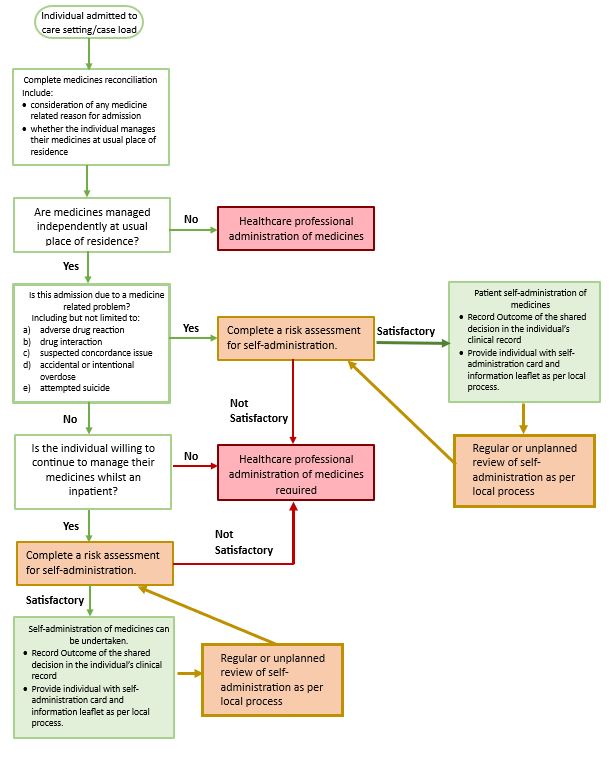
Self administration flow chart
The flow chart below shows a general overview of the individual assessment for SAM within an inpatient setting. It can be locally adapted for out of hospital care settings.
Each organisation should have a locally approved assessment process which defines whether an individual can be considered as suitable for SAM which references as a minimum:
- all materials to be used in making and recording the decision;
- how and where it is recorded that SAM is being undertaken;
- any additional resources supplied (e.g. self-administration card/medicines form or chart for completion by individuals to record administrations, information leaflets provided to support individuals/their carers including accessing resources in languages other than English).
Update history
- Republished
- Alternative description added to the 'Self administration flow chart' image to improve webpage accessibility
- Content reviewed and revised by expert working group. Article made setting agnostic.
- Title amended
- Published
- First published as HTML webpages